Turn rental properties into landlord relationships your team can work.
Start with a relevant rental property in the postcodes available to your branch. Investigate ownership where needed, review and confirm the landlord link, understand connected property context and move a live opportunity into controlled outreach or Pipeline.
The rental property is visible. The landlord relationship often is not.
Letting agents can see property activity without having the ownership evidence, connected property context or worked relationship needed to plan relevant landlord prospecting.
Ownership context may be missing
A rental property may be visible while the available ownership and correspondence information still needs investigation.
A wider relationship can be overlooked
One confirmed landlord relationship may connect to more than one property, but those links need supporting evidence and deliberate confirmation.
Timing needs evidence
Property and tenancy context can help prioritise investigation, but it should not be treated as a confirmed renewal date or guarantee of market activity.
From rental property to a relationship your team can work
Bring property context, ownership evidence, linked records and the next controlled action into one connected landlord prospecting workflow.
Start with the rental property
Review relevant lettings and off market property context across the postcodes available to the active branch.
Investigate ownership where needed
Check existing landlord links or use Land Registry credits when additional ownership evidence is required.
Confirm the landlord relationship
Review the available candidate evidence, then confirm, link to an existing landlord or reject the possible match.
Choose the next controlled action
Use an appropriate outreach path or deliberately add a commercially active landlord opportunity to Pipeline.
Keep the property, ownership and landlord source context connected as the relationship moves forward. Explore Map and property intelligence and Explore the Prospecting Pipeline.
Use landlord lifecycle context as a prompt to investigate
ProspectOS can surface relevant landlord follow up opportunities at supported points in the landlord lifecycle. These prompts help the team decide where to investigate. They do not confirm a tenancy renewal date or guarantee that a property will return to market.
Review properties recorded as recently let where a future landlord follow up plan may be useful.
Lifecycle and timing information is a prompt for human investigation. It is not a confirmed renewal date, notice date or guarantee of future market activity.
One confirmed landlord relationship may reveal more than one property
Review confirmed linked properties and supporting ownership evidence to understand the possible wider relationship behind one rental address.
Confirmed linked properties
Bring together properties that have a supported and confirmed relationship with the landlord record.
Review the possible match
Compare the available ownership and property evidence before confirming the relationship, linking it to an existing landlord or rejecting it.
Keep landlord and linked property context together
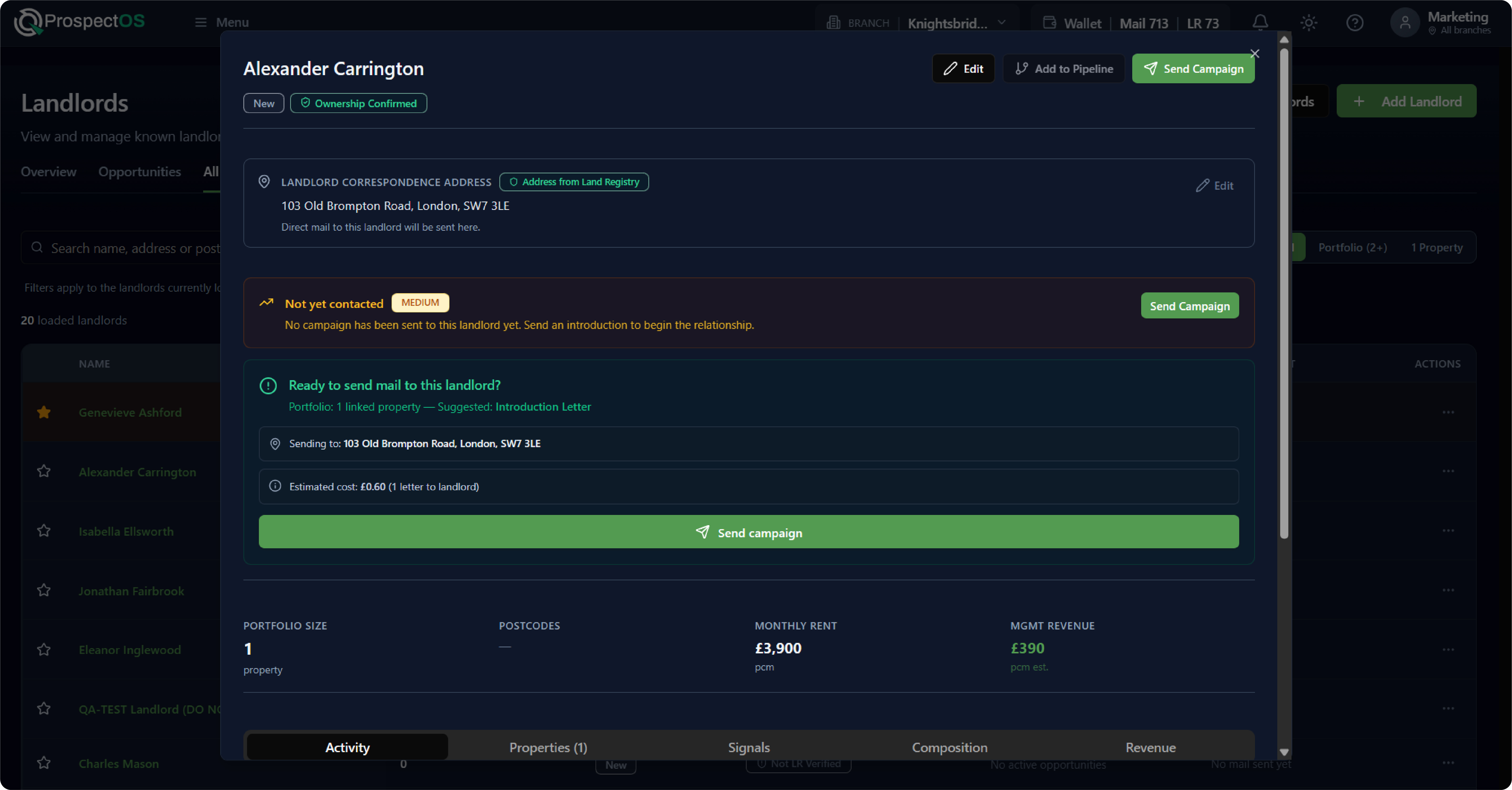
Use a branch scoped landlord book to review available identity information, correspondence details, confirmed property links, saved priorities and recorded activity.
Landlord records
Create or open a landlord record when the relationship is known or supported by available ownership evidence.
Linked properties
Review confirmed linked properties and return to the relevant property context when needed.
Saved priorities
Save priority records and add notes so the team can return to the relationship with useful context.
Correspondence check
Check that a usable correspondence address is available before preparing landlord outreach.
Pipeline action
Add a commercially active landlord opportunity to Pipeline as a deliberate action.
Landlord follow up requested after the current tenancy.
Investigate ownership without turning Land Registry into a bulk purchase
Use separate Land Registry credits when additional ownership evidence is needed. Keep the purchase, property context and available match status recorded for review.
Check existing records
Check whether an ownership record or landlord link is already available before purchasing further data.
Purchase when needed
Purchase Land Registry information when the branch chooses to investigate ownership for a relevant property.
Review and decide
Review the candidate evidence, then confirm the relationship, link it to an existing landlord or reject the possible match.
Recorded for audit
Keep the recorded purchase and property context available for audit and cost review.
Land Registry information supports ownership investigation. It does not guarantee a complete ownership picture, a usable correspondence address or contact eligibility.
| Property | Purchased | Status | Matched landlord | Next action |
|---|---|---|---|---|
| 12 Market Street, SW11 | 5 Mar 2025 | Auto matched | Example Landlord | |
| 41 Queen Road, SW11 | 2 Mar 2025 | Needs review | Suggested | |
| 8 Park Avenue, SW11 | 28 Feb 2025 | Unmatched | None |
Move a live landlord opportunity into a worked follow up
Keep the landlord and linked property context available, then use Pipeline when the relationship becomes commercially active. Assign ownership and record calls, tasks, notes, valuations and outcomes within the prospecting workflow.
A landlord record does not enter Pipeline automatically. The team decides when the relationship has become a live opportunity.
Repeat landlord prospecting rules with review and budget controls
Landlord Automations are a dedicated capability. Where enabled, teams can use supported landlord and lettings criteria with review options, activity limits and available Land Registry budget controls. Explore controlled prospecting automations.
Use supported ownership, portfolio or landlord lifecycle criteria where available, with the relevant review and activity controls.
Keep review settings, monthly activity limits and available Land Registry budgets visible for each configured landlord automation.
Keep landlord source context connected as the opportunity progresses
ProspectOS connects rental property context, ownership investigation, the confirmed landlord relationship and the next controlled action without treating every record as a converted opportunity.
Start with relevant property context
Review a rental property within the active branch and the postcodes available to it.
Investigate ownership where needed
Use existing landlord links or recorded Land Registry evidence when additional ownership context is required.
Confirm the relationship
Review the available evidence before creating or confirming the property to landlord link.
Choose outreach or Pipeline
Prepare an eligible landlord send or deliberately add a commercially active opportunity to Pipeline.
Review recorded outcomes
Recorded activity and linked outcomes can contribute to reporting when the property, landlord and source chain is complete.
Learn more about landlord prospecting
- Landlord prospecting for letting agents Investigate rental property and possible ownership context, choose appropriate outreach and manage landlord follow up.
- How lettings teams can find landlord opportunities Use rental property, ownership evidence and relationship context without overstating uncertain matches.
- How to build a repeatable lettings growth workflow Connect landlord investigation, relevant outreach, Pipeline follow up and recorded outcomes.
See the landlord opportunity behind your own patch
Book a Landlords walkthrough to see how one rental property can move through ownership investigation, relationship review and the decision to start outreach or add a live opportunity to Pipeline.
We will show one property, one ownership or matching path, the resulting landlord context and one controlled next action using safe example data.
Book your ProspectOS demo
Add your details, then choose a time.
Step 1 of 2
Book your ProspectOS demo
Add your details, then choose a time.
Step 1 of 2